

Why WER Is Not Enough
WER is useful, but it treats every word difference equally. Missing a filler word is not the same as missing a diagnosis, medication, dosage, or key symptom. Formatting differences, shorthand, punctuation, and replacement-rule candidates can also inflate WER even when the model captured the intended meaning. ErrorAlign improves this first step by aligning reference and generated transcripts in a way that better matches how a human reviewer compares speech-recognition output. BeWER uses that alignment to produce reports with WER, CER, optional MTR, and token-level differences that you can inspect. Tympany wraps this workflow in one local tool. It runs BeWER directly, gives you a web UI for reviewing the report, and lets you decide which differences should count against the model.Getting Started
Run Tympany locally with the following:Tympany is designed to run on your machine or in your own single-tenant environment. Transcript data can contain PHI or PII, so local-first evaluation helps you keep sensitive output under your control.
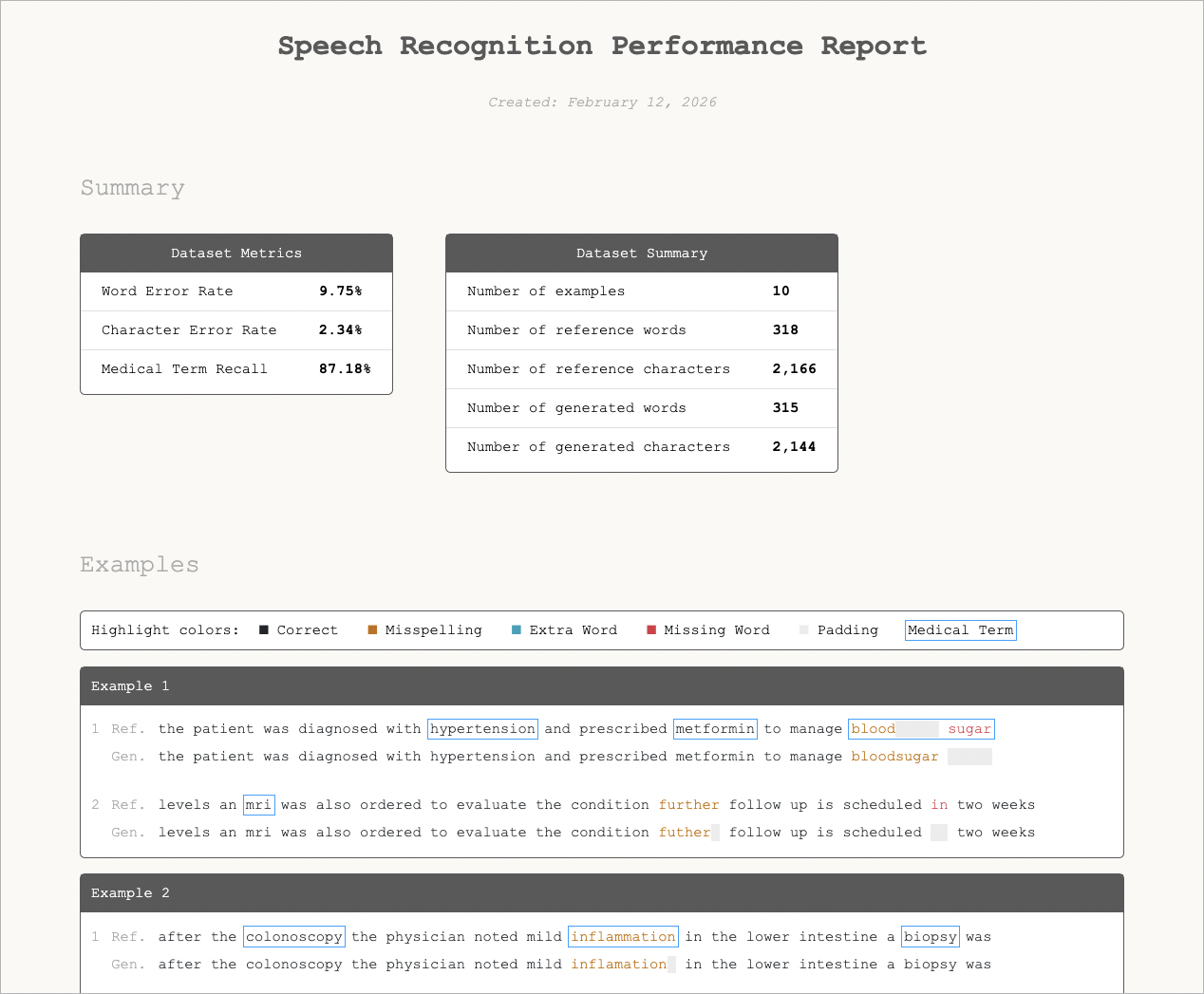
Create and Analyze BeWER Reports
Tympany supports two main workflows:- Create a BeWER report from pasted text or a CSV containing reference and generated transcript pairs. Tympany evaluates the pairs with BeWER, computes WER and CER, and can compute MTR when you provide a medical term list.
- Analyze a BeWER report in the web UI. Tympany classifies each difference, lets you exclude non-model errors, and re-runs the evaluation so you can see the updated WER, CER, and MTR.
Understand the Ecosystem
Tympany is the recommended starting point for local review, but it builds on the same evaluation ecosystem that powers the lower-level tools. If you prefer a command-line workflow, Corti Canal can still generate a self-contained HTML report.Tympany
Create BeWER reports, analyze errors in a local web UI, exclude non-model differences, and recompute error rates.
BeWER
Generate Beyond WER reports with WER, CER, optional medical term recall, and token-level alignment details.
ErrorAlign
Align reference and generated transcripts using an evaluation method designed for modern speech-recognition error analysis.
Corti Canal
Use the command-line reporting workflow when you want a self-contained HTML report outside the Tympany web app.
Data Handling and Optional LLM Review
Tympany stores generated reports, analysis history, and saved medical term lists in a local data directory by default. Corti credentials are optional and only enable the LLM second pass. Without them, Tympany still runs the rule-based classification locally. When Corti credentials are configured, Tympany can run an optional LLM second pass for uncertain errors, such as context-dependent differences or possible misrecognitions. If you host Tympany for a team, put it behind your own access control, such as VPN, SSO proxy, or an IP allowlist.What This Enables
Instead of only asking:“What is the WER?”You can answer:
“Which errors matter, which ones are fixable outside the model, and what is the updated error rate after those differences are excluded?”
See supporting speech-recognition research: